
Understanding stress, regulation, and how your nervous system protects you
Nervous System • Somatic Support • Polyvagal-Informed
Your body is not failing you. It is protecting you.
When your nervous system is activated, overwhelmed, shut down, or stuck in “too much,” it’s not because you’re weak. It’s because your body is doing what it was designed to do: keep you safe. This page is a doorway back into choice.
How the nervous system works
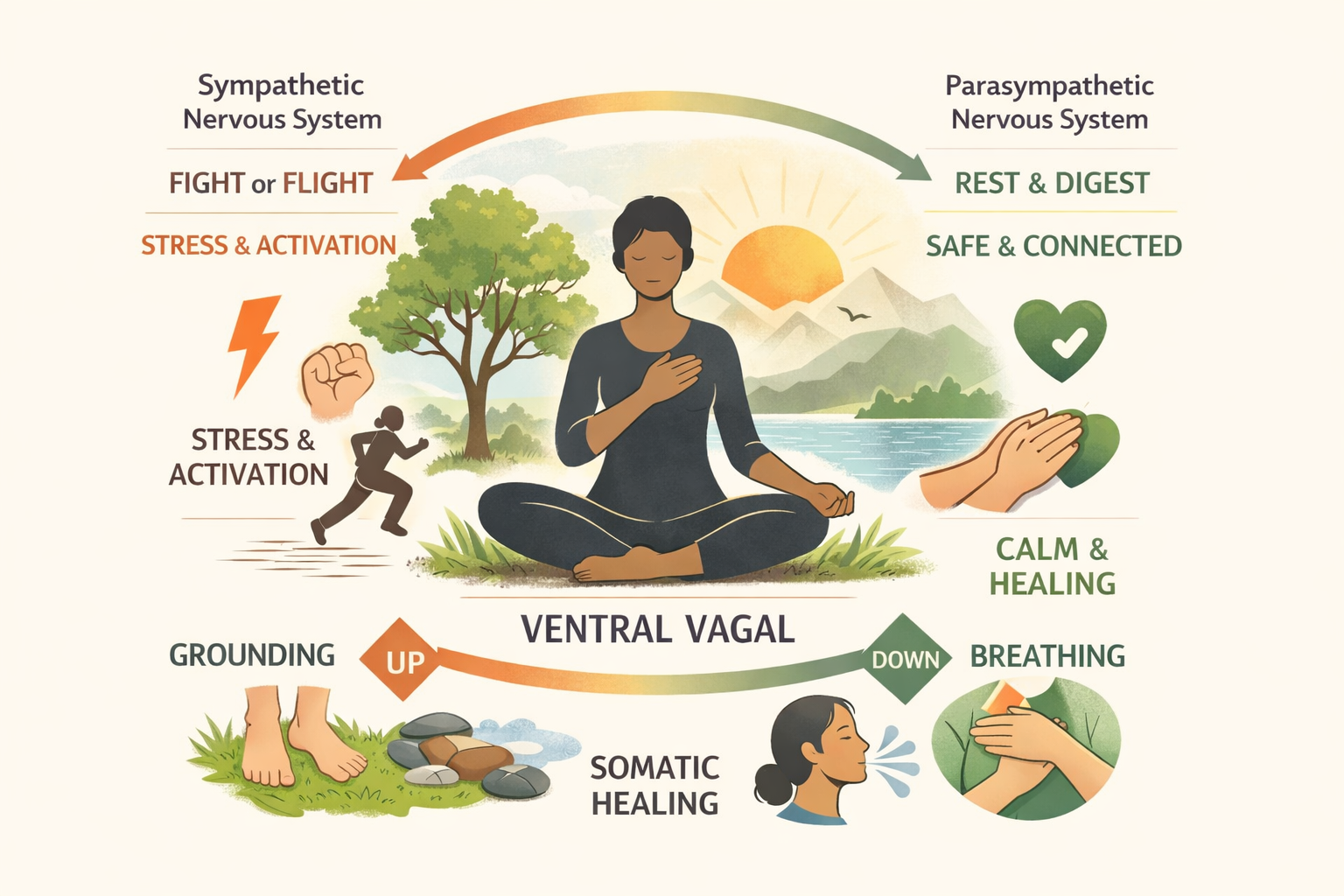
Your nervous system is your internal safety system. It scans the world and your inner experience for cues: danger, uncertainty, rejection, pressure… and also safety, warmth, connection, predictability. Then it shifts your body into the state it believes will protect you — often before you even have a thought about it.
It’s adaptive
A stress response is not “wrong.” It’s an intelligent system responding to perceived threat. Sometimes threat is real and present. Sometimes threat is remembered — from past experiences your body still carries.
- Activation: energy rises to protect (anxiety, urgency, irritation, panic, racing mind).
- Shutdown: energy drops to conserve (numbness, fog, exhaustion, disconnection).
- Connection: steady energy returns (presence, clarity, warmth, capacity).
It learns through experience
Your nervous system learns safety through repetition — not through willpower. That means small practices matter. It also means shame is the fastest way to keep the alarm on.
A simple map of states
This is a practical polyvagal-informed map. Use it as orientation: “Where am I right now?” Then choose the smallest supportive action that matches your state.
Feels like: urgency, tension, restlessness, spiraling thoughts, anger, panic, scanning for problems.
Trying to do: mobilize energy to protect you.
- Best first move: longer exhale (signals “stand down”).
- Then: orient to safety (look around slowly, name what’s safe/neutral).
- Then: grounding (feet pressure, weight, steady touch).
Feels like: fog, numbness, heaviness, “I can’t,” dissociation, scrolling without relief.
Trying to do: conserve energy and reduce pain when overwhelm is too big.
- Best first move: warmth (tea, shower, blanket) + hydration.
- Then: tiny movement (hands/shoulders/standing sway).
- Then: gentle connection cue (safe text, voice note, supportive audio).
Feels like: grounded, warm, clear, capable, connected, able to tolerate discomfort without losing yourself.
Makes possible: learning, repair after rupture, creativity, intimacy, boundaries, calm decisions.
- Best move: protect this state with rhythm and boundaries.
- Practice: one values-aligned step (small, real, doable).
- Anchor it: nature, play, supportive connection, meaningful routine.
Feels like: people-pleasing, over-explaining, guilt, shrinking needs, fear of conflict, “I’ll just handle it.”
Trying to do: reduce relational threat to keep connection and safety.
- Best first move: feel your feet + slow your voice.
- Then: name one need privately before responding.
- Try: “I need us to slow down and keep our tone gentle.”
Restoring safety
Safety isn’t only a thought. It’s a body experience. When you’re overwhelmed, the nervous system stops trusting words. It starts trusting signals: breath, rhythm, warmth, orienting, and relationship. We restore safety by building credibility.
What actually helps (not just what sounds good)
- Downshift signals: longer exhale, soft eyes, slower movements, lowering stimulation.
- Stabilizing signals: steady pressure, one-thing focus, simple rhythm (tap, rock, walk).
- Up-shift signals: warmth, hydration, music, micro-movement, sunlight, gentle novelty.
- Relational signals: kind tone, paced speech, being understood, repair, safe presence.
The 5% rule
When you’re dysregulated, aim for 5% more safety — not 100% calm. Your nervous system can move in small increments. Small increments create trust.
Somatic Therapy Pathways
Somatic work is nervous system language. Choose the pathway that matches your state today — and do it gently.
Downshift
Best for: anxiety, panic, urgency, anger, overstimulation.
- Breath: exhale longer than inhale for 60 seconds.
- Orient: slowly look around and name 5 safe/neutral things.
- Ground: press feet into the floor for 10 seconds, release, repeat.
Micro script
Stabilize
Best for: overwhelm, flooding, spirals, scattered attention.
- Containment: both hands on thighs with gentle pressure.
- One-thing focus: feel feet OR hands for 20 seconds.
- Rhythm: slow tapping or rocking for 60 seconds.
What you’re building
Stabilizing is the bridge between survival mode and clarity. It teaches your body: “I can come back.”
Up-shift
Best for: numbness, shutdown, heaviness, fog, disconnection.
- Warmth: tea, shower, blanket, heating pad.
- Tiny movement: roll shoulders, stretch hands, stand and sway.
- Sound: music with steady beat, humming, gentle vocal tone.
Micro script
Co-regulation
Best for: when your body needs relational safety and you can’t do it alone.
- Voice: calming audio, guided breath, supportive reading.
- Presence: sit near someone safe; ask for quiet presence (not fixing).
- Repair: name what you need in one clean sentence.
Boundary sentence
Instant tools
Choose one. Do it imperfectly. Let it count. Repetition teaches your body what works.
Tool 1: Longer Exhale (60 seconds)
Inhale gently. Exhale a little longer. Longer exhale tells the body: “We can stand down.”
Tool 2: Orienting (45 seconds)
Slowly look around. Name 5 safe/neutral things you see. Let your eyes rest on one steady object for one breath.
Tool 3: Feet Pressure Grounding (30 seconds)
Press both feet into the floor as if you’re gently making an imprint. Hold 10 seconds. Release. Repeat.
Tool 4: Containment Hold (30 seconds)
Place both hands on your thighs. Apply gentle steady pressure. Drop your shoulders one degree. One breath.
Amee’s 20-Second Safety Script
Click “another version” until one lands like truth in your body. Copy it into Notes or your journal.
Somatic Therapy Pathways resources
These buttons are placeholders for the next tools you’re building: audio, visuals, worksheets, and guides. Swap the links when your pages are ready.
Audio tools
Guided regulation when you can’t think your way through it.
Worksheets and guides
Printable tools that build nervous system literacy over time.
When the nervous system meets relationship
If your nervous system is activated because of rupture, conflict, or ongoing relational stress, you may need tools that combine regulation with communication. That’s where The Third Chair helps.